Showing posts with label History Lessons. Show all posts

Monday, June 20, 2016

Can You Count to 43?

DS shares a June 14 birthday with my lovely grandmother, who at just over twice his age, turned ninety six days ago.

DS celebrated his birthday solo in NYC this week. BUT, he flew in last weekend for a whirlwind of activities, not the least of which included our going-away party, Reese's (early) 7th birthday party, and some grab-and-go birthday moments of his own.


A private bike tour of Amsterdam has been on my bucket list for a while now, and I really hoped if I found the right tour guide, someone who understood we'd been here for three years and wanted to dive a little deeper, it could be a fun birthday present for DS. So, I gave it a shot.
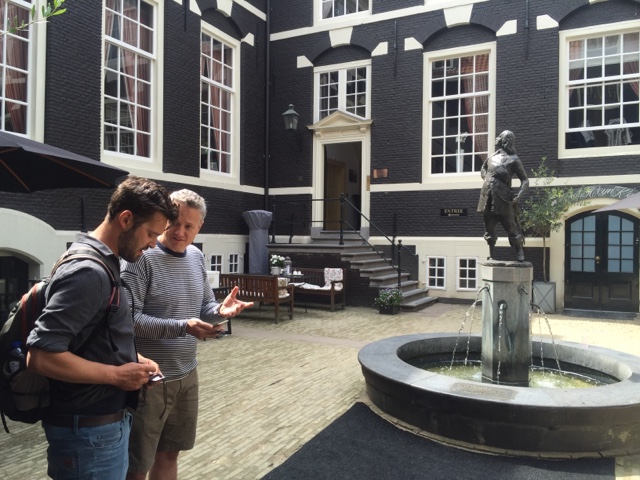
Turns out, we hit the jackpot with an amazing guide, a late twenty-something named Jasper, who started his own bike company, WE BIKE AMSTERDAM, just for this kind of thing, and we enjoyed a fab afternoon on a reluctant sunny day biking around Amsterdam.


We're standing in front of the 17th-century headquarters of the Dutch West India Company. It's obvious, but the famous Dutch East India Company went east, and the West Indies company went west. One of the latter's famous investors was Mr. Henry Hudson, who gobbled up land where???? New York. 

Hello, "Hudson" River. 

The statue is Peter Stuyvessant, governor of New York from 1647-1664 (until it was basically ceded to England). Unbelievably, he was the seventh Director-General of New Amsterdam, and he started his new job in 1647. Jeez.

And he was a pretty important dude in the early history of New York, working hard to expand the Dutch settlement beyond the tip of Manhattan Island. He is credited with "Wall Street,' which at the time was an actual wall to protect the city (and from where we get the now totally unrelated name of U.S. stock market), with the canal that became Broad Street, and with Broadway.


I've been wanting to explore examples of the Amsterdam School, an architectural style that emerged between 1910-1930 as a response to the blockish, "harsh" architecture that preceded it. The architects of this school focused on workers housing and government buildings, and the style is characterized by:

"Buildings of the Amsterdam School are characterized by brick construction with complicated masonry with a rounded or organic appearance, relatively traditional massing, and the integration of an elaborate scheme of building elements inside and out: decorative masonry, art glass, wrought ironwork, spires or "ladder" windows (with horizontal bars), and integrated architectural sculpture. The aim was to create a total architectural experience, interior and exterior."

This is a must-see example of the Amsterdam School: Het Schip (The Ship). For the very reason that from a distance it looks like a ship, in addition to many ship-like details.


Always a bit of art deco in the Amsterdam School . . . check out the address numbers.


It was such an awesome day.

We capped it off with Dutch gin at one of the oldest "brown cafes" in Amsterdam, Cafe Papeneiland (Pope Island Cafe), which was a place of secret worship for Catholics when the Protestants pushed the Spanish out and took over the city. There's even a secret tunnel that supposedly went under the canal so people could get to clandestine places of worship (I could go on and on about all of the secret churches in Amsterdam). This bar is literally right out of the Golden Age.


While I'm at it, HAPPY FATHER'S DAY to our favorite guy. We love you. We miss you.

Friday, June 17, 2016

Suffragette

I just watched this, and like Hillary or not, it's pretty damn cool that a woman clinched the presidential nomination of a major party, and could become President of the United States. We've come along way in 96 years, since women received the right to vote in the U.S. And, fyi, did you know Switzerland only gave women the right to vote in 1971?

This was a pretty decent story of the suffrage movement in Great Britain, where women got the right to vote in 1928.


Wednesday, October 14, 2015

A Pilgrim-y Birthday for Mama

It was a lovely day in Leiden, where the gang took me to celebrate my birthday on Saturday.

Leiden is a university town, and it became so in the 1600's when it threw off Spanish rule. William Orange, boss of The Netherlands at this time, offered the town the choice of no taxes or the founding of a university.

Leiden residents opted for a university, which proved to be a smart decision because the town went on to become a renowned intellectual center.


Now, pretty please!  Hang with me here.  I've got a Colonial history alert!

The pilgrims who fled England, and then showed up on Plymouth Rock?

They hung out in Leiden between 1609-1620.

The Pilgrims took up temporary residence in Leiden because Holland was tolerant of most religions, and it gave them time to raise money and organize before setting sail for North America. But, guess what? When they took off from the harbor at Delfthaven, it turned out their ship was not seaworthy, so they swung by England again to jump on board another ship full of more pilgrims fleeing England.  The name of that ship? THE MAYFLOWER. Yup, many of the original settlers in New England first spent a decade in Holland.

The famous minister, Edward Winslow, who wrote the pamphlet telling the story of the first Thanksgiving? He was one of the folks who lived in Leiden before becoming a major leader and founder of the Plymouth Colony.

Food for thought, as Thanksgiving approaches. Oh, and fyi . . . no fewer than seven U.S. presidents are direct descendants of the Leiden pilgrims. No joke.

And here's another historical kicker: Rembrandt was born in Leiden. In 1606.  This would have made him an early teen while all those pilgrims were milling about. Interesting overlap, huh? Rembrandt eventually moved to Amsterdam when he was twenty-six, where, of course, he became kind of famous.  Then bankrupt.

Anyway.

It was a beautiful fall day on the canals.  Leiden is one of a handful of cities in The Netherlands built around a canal system, but it's much, much smaller than Amsterdam.  Very collegiate, with lots of trees and broad lanes. Cozy.


We had a fun sushi birthday picnic on the boat!  Thanks for the idea AKS!


There's actually quite a bit of documentation about the Pilgrims' time in Leiden, and this gentleman has made it his life's work to know every detail about this period.  He re-created a seventeenth-century interior, inside a fourteenth century house, with authentic, local, period pieces.

This teeny-tiny Pilgrim Museum is strange, but at the same time, strangely interesting.


The house was built in the 1300's for the clergy who tended to the neighboring church.  That's a portrait of Edward Winslow hanging in the photo above.

The chair in the photo below is 800 years old. The museum director let Reese sit in it.


  This processional banner is also 800 years old:


Here's the neighboring church.  It's not even the most important or architecturally grand cathedral in Leiden.  A & R sure look tiny.


Thursday, June 11, 2015

John Adams in Amsterdam

Before John Adams became the second President of (a very new) United States of America, he could be found hanging out in Amsterdam.  In fact, he was here as the first US ambassador to the Netherlands during the 1780's.

While doing his diplomatic duties in Holland, Adams lived very modestly in the home of a widow on a side street somewhere in Amsterdam.  However, when his co-revolutionaries back home asked him to secure a loan of ten million dollars, Adams had to prove his status so the Dutch leaders would take him seriously.  He moved to this lovely canal house at Keizersgracht 529, built in 1760 and still in its original state.  Read more here

Here's our Abigail on the very steps where Adams once came and went.  Our Abigail, who was partly named in honor of a very cool woman in American history--Abigail Adams, John's wife, confidante and sometimes co-politician.


This was Adams' view from his new house. Abby's ballet and piano classes are right around the corner.


Needless to say, I don't know that his new lodgings helped him out much with Dutch councilors, who were skeptical about supporting the American cause (only France had recognized the revolution at this point).

And, conversely, Adams was not exactly enamored with the Dutch, of whom he said the following. 
"I have been in the most curious country among the most incomprehensible people and under the most singular constitution of government in the world".

"The councils of this people are the most inscrutable I ever saw."
I laughed out loud about the "endless consultations," which are still very much a part of Dutch workplace culture.  Not to mention, Adams also thought the Dutch were not very well-read and badly informed about international developments.

If you've never seen the HBO series "John Adams," it is soooooo good.  Well worth the time investment. I got such a kick out of the clip from the mini-series when Adams pleads his case in front the Dutch councilors!  Paul Giamatti and Laura Linney are perfect as John and Abigail.

Just follow this link to YouTube:


Adams eventually got a loan of two million dollars, not quite the 10M he'd hoped for, and it only came after he'd suffered a six-month bout of malaria, which he probably contracted from living near the canal.  But everyone was happy, and the house Adams bought in The Hague became the very first embassy in American history.